



Table of Contents
- What Separates a Good Aftermarket Seat From a Great One
- The Best Aftermarket Seats for Harley-Davidson, Compared
- Harley-Davidson Touring Seats: The Wall and Widowmaker for Baggers
- Harley Dyna Seats: Fitting 1996-2017 Dyna and Wide Glide Models
- Saddlemen Road Sofa Seat Review: How It Compares to Custom Options
- Harley-Davidson Solo Seat vs Two-Up: Matching the Seat to Your Ride
- Installation, Returns, and What to Know Before You Order
- Conclusion: Choosing the Right Seat for Your Harley
- Frequently Asked Questions
Last Updated: October 6, 2026
What Separates a Good Aftermarket Seat From a Great One
The best aftermarket seats for Harley Davidson solve a problem the factory never does: they match a seat to a specific rider, bike, and kind of riding.
Here's the part most guides skip. A seat can be wide, plush, and expensive and still wreck your back after two hours, because width and softness are not the same as support. The Motorcycle Safety Foundation rider resources consistently point riders toward seating that keeps them stable and in control, and that principle applies to comfort too.
Below, we break down what actually decides comfort, then compare the seats we build for touring and Dyna platforms.
Fit Criteria That Decide Comfort Before You Buy
Fit is the single biggest factor in whether an aftermarket seat works for you. Four measurements decide it: seat width, seat height, seating position, and how far back the seat sits you.
- Seat width: A wider seat spreads pressure, but too wide forces your legs out at stops.
- Seat height: Taller padding raises you; thinner foam drops you closer to the controls.
- Seating position: Some seats sit you down into the bike. Others sit you back a couple of inches.
- Rider posture: Aggressive seats push you forward; touring seats open your hip angle.
A common mistake is buying for looks first. A bulky profile that photographs well can lock your hips in a position that hurts after an hour. Measure your inseam, note your bar reach, and decide whether you want to sit down, sit back, or stay neutral before you spend anything.
Foam, Leather, and Break-In: What Lasts
Materials decide how a seat feels on day one and in year three. Foam density matters more than thickness, and the cover material decides how the seat ages.
Our seats use Comfort Cell® foam with genuine leather panels. Dense foam holds its shape instead of collapsing into a trench. Leather breathes and molds to your shape over time, which is why a good seat gets better in the first few hundred miles rather than worse. Diamond pattern stitching is standard unless you specify otherwise.
The Best Aftermarket Seats for Harley-Davidson, Compared
Every seat we build starts at $593 and is made to order in the USA. Two shapes cover most riders: The Wall, a fastback with seven inches of vertical back support built for aggressive riding, and The Widowmaker, which adds a removable backrest option and suits solo or short-to-medium trips.

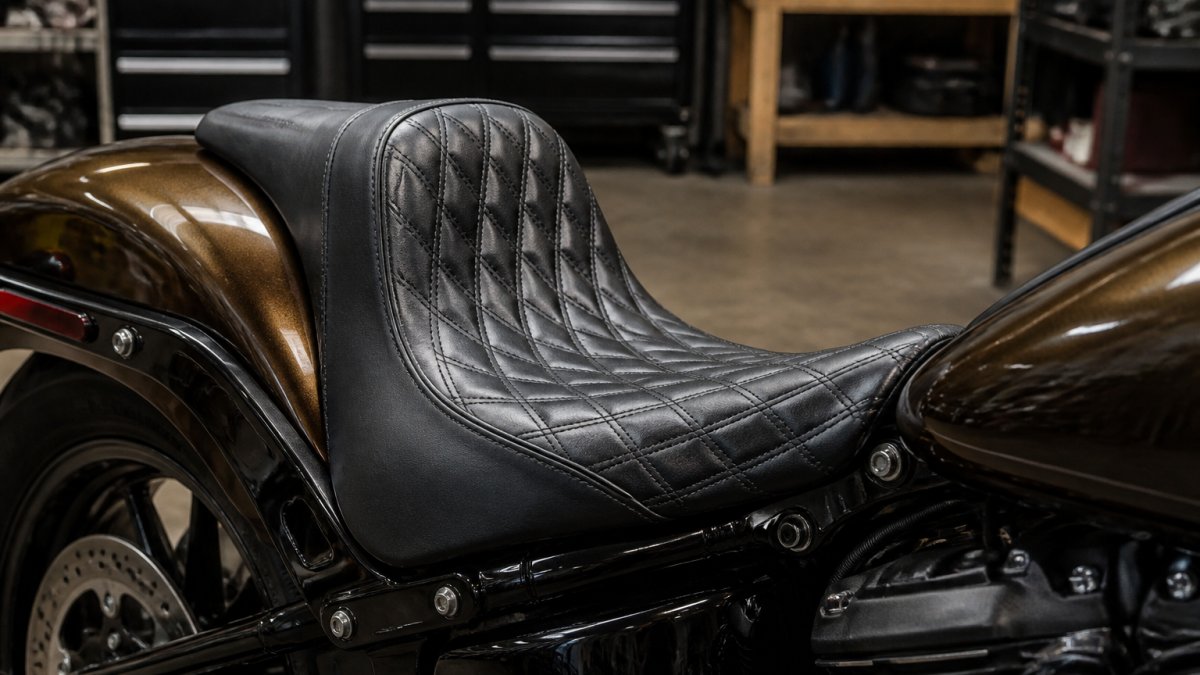
The Wall is our pick for riders who want to be locked in place. Seven inches of vertical back support gives your lower back something to push against under acceleration.
Neither shape is right for every rider. The Wall's tall back support feels restrictive if you shift around in the saddle, while The Widowmaker's lower profile gives less lower-back bracing on a long haul. Knowing which trade-off you want is most of the decision.
Seat Feature and Price Comparison
| Seat | Shape | Back Support | Best For | Price |
|---|---|---|---|---|
| The Wall | Fastback | 7 in. vertical | Aggressive riding, locked-in posture | $593 |
| The Widowmaker | Low-profile | Removable backrest option | Solo and short-to-medium trips | $593 |
Both seats are built to order with over 50 material options, so the price holds regardless of cover. That flat pricing is deliberate: we'd rather you pick the material you want than compromise to hit a lower tier.
Harley-Davidson Touring Seats: The Wall and Widowmaker for Baggers
For Road Glide, Street Glide, and Electra Glide owners, the touring seat decision comes down to back support versus a low profile. Both The Wall and The Widowmaker fit 2009-2026 touring models.

Touring riders put in more hours than anyone, so lower-back support matters most. The Wall's seven inches of vertical support addresses the exact complaint we hear from bagger owners: a wide seat that still leaves the lower back with nothing to lean against. The Widowmaker suits riders who want a sleeker look, and its removable backrest gives support when you want it.
Passenger comfort is the other half of the touring equation. If you ride two-up, we build the seat around both riders, not just the one at the bars.
Harley Dyna Seats: Fitting 1996-2017 Dyna and Wide Glide Models
Dyna riders get the same two shapes, fitted to a different frame. The Wall and The Widowmaker both cover Dyna 1996-2017, Dyna Switchback 2012-2016, and Wide Glide 2006-2008 and 2010-2016.
Dyna owners tend to ride harder and sit more forward than touring riders, so posture matters more here. The Wall's fastback shape suits the aggressive, hot-rodded Dyna build and keeps you planted on the throttle. The Widowmaker's lower profile fits the cleaner, stripped-down look many Dyna riders want.

Model compatibility is where Dyna buyers get burned most often. The Wide Glide's year gaps are real: 2006-2008 and 2010-2016, with 2009 excluded. If you own a 2009 Wide Glide, confirm fitment before ordering rather than assuming the seat covers your year.
Saddlemen Road Sofa Seat Review: How It Compares to Custom Options
A Saddlemen Road Sofa seat review usually lands on the same conclusion: it's a well-known off-the-shelf touring seat with a plush, wide profile. The catch is that off-the-shelf means one shape for every rider, and shape decides comfort.
BMC/Corbin Wall Seat - Road Glide/Street Glide 2009-2026 →
Custom seats take the opposite approach. Instead of picking the closest stock shape and living with it, you specify the width, position, and material that fit your body and bike. That's why riders who've bounced between off-the-shelf options often end up going custom.
Price is the honest trade-off. A custom seat costs more than a mass-produced one, and you wait for it to be built. In return you get a seat shaped to your measurements, covered in the material you chose, made in the USA, and backed by a 1-year warranty on manufacturing defects.
Harley-Davidson Solo Seat vs Two-Up: Matching the Seat to Your Ride
The solo or two-up decision comes before shape and material, because it changes everything downstream. A solo seat lets us build a narrower, more sculpted shape with no compromise for a passenger. A two-up seat has to serve two riders with different needs.
Riders who mostly ride alone should lean solo. You get a seat shaped entirely around one body, which means better support and a cleaner line on the bike. The Widowmaker suits this well, and its removable backrest adds support for longer solo trips.
Riders who carry a passenger need a two-up build, and that means telling us about both riders. Passenger comfort depends on seat width, padding, and backrest support, and an uncomfortable passenger ends the ride early for both of you. We build two-up seats around both sets of measurements.
Installation, Returns, and What to Know Before You Order
Installation is straightforward on a correctly fitted seat, but "correctly fitted" is doing a lot of work there. Here's how to avoid the return.
Where it goes wrong. The friction is almost never the hardware, it's fitment. Three failure points cause most returns:
- Model year, not model name. Mounting points and tank/frame geometry change between year ranges even on the same model. A seat listed for 2009-2026 touring models won't necessarily drop onto every year in that range without confirming the bracket.
- Two-up vs. solo hardware. Switching from a two-up to a solo seat (or the reverse) can require a different rear bracket or a fender bib to cover exposed mounting points.
- Backrest and luggage racks. A removable backrest or a luggage rack can share mounting real estate with the seat, so confirm they coexist before ordering.
Fit check before you commit. With the seat in place but before you tighten anything, sit on the bike with feet on the pegs and hands on the bars.
Warranty. Warranties typically cover manufacturing defects, stitching failures, foam defects, cover separation, not wear, sun damage, or a seat that simply doesn't suit you.
- Confirm your model and exact year range
- Decide solo or two-up before choosing a shape
- Note whether you want to sit down, sit back, or stay neutral
- Check whether your backrest or rack shares mounting points
- [ ]
- Read the warranty's covered vs. excluded items
Before you order, ask two questions: does this seat fit my exact year, and does this shape match how I ride? If both answers are yes, installation is a bolt-on job.
Conclusion: Choosing the Right Seat for Your Harley
The best aftermarket seats for Harley Davidson aren't the widest or most expensive. They're built for your body, your bike, and the way you actually ride. Get the fit criteria right, choose between The Wall's locked-in back support and The Widowmaker's flexible profile, and match the seat to solo or two-up riding first.
At BMC Motorcycle Company, every seat is handcrafted in the USA with Comfort Cell® foam, genuine leather panels, and over 50 material options to match your build. Each one is backed by a 1-year warranty on manufacturing defects, and rated 4.9/5 by 2,847 riders. Get started with BMC Motorcycle Company and build a seat shaped around you, not the average rider.
Frequently Asked Questions
Are Saddlemen seats worth the money compared to a custom seat?
Saddlemen's Road Sofa is a popular off-the-shelf touring option, and it works well for riders who want a quick upgrade without waiting on a build. A custom seat from BMC starts at $593 and lets you choose materials, foam density, and shape for your specific bike and body. If you ride long distances or carry a passenger, the custom route often pays off in comfort and durability.
What is the most comfortable motorcycle seat for long rides?
Comfort on long rides comes down to foam quality, width, and back support, not just padding thickness. BMC's The Wall seat adds seven inches of vertical back support and uses Comfort Cell foam with genuine leather panels. For touring bikes like the Road Glide or Street Glide, that combination holds up over hours in the saddle better than a stock or thin aftermarket cushion.
How do I choose an aftermarket seat that fits my Harley-Davidson model?
Match the seat to your bike's model and year range before anything else. BMC lists fitment by platform, for example Road Glide and Street Glide 2009-2026, Softail 2018-2026 including Fat Boy and Heritage Classic, Lowrider S/ST 2018-2026, and Dyna 1996-2017 with Wide Glide 2006-2008 and 2010-2016. Confirm your year falls in the listed range, then pick solo or two-up based on how you ride.
Are solo seats or touring seats more comfortable for long rides?
It depends on whether you carry a passenger and how much back support you want. A Harley-Davidson solo seat gives a locked-in position and a cleaner profile, which suits aggressive riding and cafe builds. Touring seats add width, passenger room, and often a removable backrest, which most riders prefer for road trips. If you ride two-up regularly, a touring or dual seat is the practical pick.
What is the best motorcycle seat cushion for long rides?
The cushion matters less than the seat's overall shape and foam. BMC seats use Comfort Cell foam with genuine leather panels, and The Wall model adds seven inches of vertical back support to keep your posture stable. A cushion can help temporarily, but a seat built with the right width, firmness, and back support for your body will do more for comfort over a full day of riding.